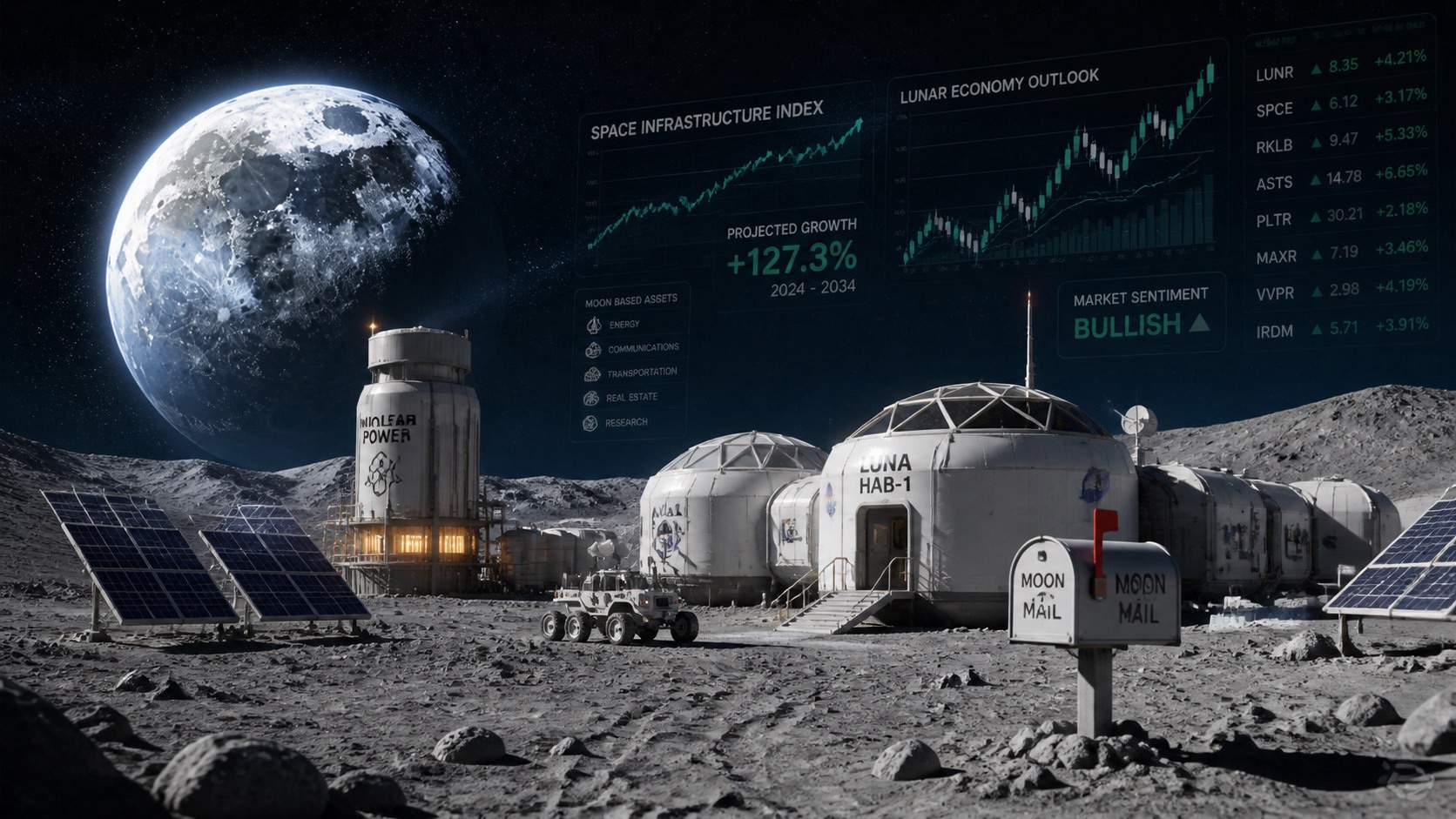
NASA has moved the Moon from “bucket list destination” to “up‑and‑coming neighborhood.” In a newly unveiled blueprint, the agency laid out plans for a permanent lunar base that will house astronauts, deploy fleets of lunar vehicles, and run on a hybrid energy mix of solar arrays and nuclear power stations. This is not a flags‑and‑footprints reprise of Apollo; it is an infrastructure build‑out designed to make the Moon a working asset—and, by extension, a new frontier for capital.
NBC’s Tom Costello framed it as unprecedented news as NASA detailed its schedule: robotic precursors in the near term, followed by a phased build of habitats, power systems and surface logistics under the Artemis program. The stated goal is plain: establish a sustainable outpost on the lunar surface and use it as a proving ground for technologies and operations that ultimately push humans on to Mars.
Why NASA Is Going All‑In Now
Behind the poetry of “returning to the Moon” is a very Earth‑like calculus: strategic leverage, technological primacy and industrial policy. NASA’s internal planning casts the Moon base as a platform to develop, test and demonstrate systems for future Mars missions, from life‑support and in‑situ resource utilization to next‑generation propulsion. A functioning lunar outpost also positions the U.S. to help set norms around resource extraction, surface traffic and safety protocols—rules that look suspiciously like tomorrow’s property law.
The timing is not accidental. A push from Washington has NASA and its partners accelerating work on space‑qualified nuclear power and surface infrastructure, even as international competition intensifies and other nations sketch their own lunar ambitions. In that context, the Moon starts to look less like a scientific pet project and more like the high ground in a multi‑decade geo‑economic contest.
The Power Problem: Two Weeks of Day, Two Weeks of Night
On Earth, energy planners worry about peak load; on the Moon, they worry about surviving a night that lasts roughly 14 days. That simple orbital fact turns energy into the make‑or‑break variable for any permanent outpost. Solar power is attractive on the sunlit rim of the lunar south pole, where some ridges enjoy near‑continuous illumination, but even there dust, shadows and the long night make it an unreliable single point of failure.
Enter compact nuclear fission systems. Early concepts centered around reactors roughly in the tens of kilowatts—enough to power a small neighborhood—but the outpost NASA now imagines will demand far more to run habitats, logistics and science payloads. These reactors are being engineered to run continuously for years without refueling, largely indifferent to lunar dusk, regolith dust and the awkwardness of solar panels at minus 200 degrees Fahrenheit. For investors, that sounds a lot like the birth of a new, highly specialized power‑equipment category: off‑world baseload.
Surviving Dust, Radiation and a “Steady Rain” of Space Gravel
If the Moon base sounds like a frontier resort, it is the kind where the brochure mentions “micrometeoroid impacts” in the fine print. With no atmosphere, astronauts and hardware face a mix of radiation, brutal thermal swings—up to 250 degrees Fahrenheit in daylight and below minus 200 at night—and a constant drizzle of high‑velocity dust grains and rock fragments. Even tiny particles can punch through metal at orbital speed, which is not the kind of home improvement challenge typically tackled at the local hardware store.
Modeling suggests that a base at the lunar south pole, the leading candidate for Artemis operations, would face many thousands of micrometeoroid impacts per year—far fewer than an equatorial outpost, but still enough to keep engineers conservative. The upside is that most particles are too small to pose a structural threat if habitats are properly shielded, giving designers room to pursue more ambitious structures, including concepts like transparent domes that shelter against radiation and impacts while still offering astronauts a view that will likely become the most photographed skyline in human history.
From Science Fiction to CapEx Line Item
Strip away the lunar poetry and what emerges is a familiar pattern: a government‑led mega‑project seeding an ecosystem that private capital can scale. Artemis hardware already taps a sprawling supply chain of launch systems, robotics, advanced materials, life‑support and automation. Layer on top a requirement for nuclear reactors that can operate in hard vacuum, thermal regulation solutions that function across 500‑degree Fahrenheit swings, and communications architectures resilient to lunar dust and line‑of‑sight quirks, and you have a multi‑sector technology stimulus hiding inside a space narrative.
For public‑market investors, the direct “pure plays” in lunar real estate remain more aspirational than actionable. But the enabling technologies—radiation‑hard electronics, high‑efficiency power management, advanced ceramics and alloys, nuclear fuel cycle services, autonomous robotics and precision manufacturing—already have tickers and earnings calls. A permanent Moon base forces those companies to design not just for the next product cycle but for environments where spare parts are a three‑day trip away at orbital velocities, which tends to raise both margins and barriers to entry.
The New Launch Monopoly: From Rockets to Ecosystems
Any permanent lunar presence depends, quite literally, on getting there—and that is where the commercial heavyweights come in. SpaceX has become the de facto headline name in reusable launch, and speculation about a future SpaceX IPO has turned into a recurring parlor game on Wall Street, with investors gaming out how a listing might reprice the entire space‑infrastructure complex. Were the company to join public markets, exposure to its launch cadence and lunar cargo contracts could quickly become a proxy for the health of the broader cis‑lunar economy.
Blue Origin, meanwhile, is positioning itself as a deep‑pocketed rival with its own heavy‑lift vehicles, lunar lander concepts and an explicit vision of millions of people living and working in space. For NASA, that competitive dynamic is a feature, not a bug: multiple providers mean redundancy for critical missions, downward pressure on cost per kilogram to orbit, and a broader industrial base able to support everything from cargo runs to crewed flights. For investors, it frames the Moon not as a one‑company story, but as an emerging ecosystem in which launch becomes the toll road feeding all downstream activity.
Semiconductors in Space: Why Astera Labs Belongs in the Conversation
Moon bases do not run on dreams; they run on data—and that is where a name like Astera Labs, Inc. (ALAB) quietly enters the frame. The company designs connectivity‑focused semiconductor solutions that help move data quickly and efficiently between compute, storage and accelerators in modern data centers. Translate that to a lunar context and you get a pretty good mental model for what a Moon base’s digital nervous system will need: low‑latency, high‑bandwidth interconnects that can survive harsh environments and support AI‑driven autonomy at the edge.
While Astera Labs is not branding itself as a “space stock,” the same architectures that support cloud and AI workloads on Earth are the ones that will be called on to manage sensor networks, robotics fleets and mission‑critical compute off‑world. From an investor’s lens, that positions ALAB as part of the upstream picks‑and‑shovels trade on the data side of the space economy. You may never see its logo on a rocket fairing, but its design wins in hyperscale and AI could end up being the same competencies that future lunar infrastructure quietly depends on.
Sample positioning table for investors
| Theme | Example names | Role in lunar story |
|---|---|---|
| Reusable launch | SpaceX (future IPO?) | Heavy‑lift to orbit and cis‑lunar logistics |
| Alternative launch | Blue Origin | Competing lift, lander and cargo services |
| Data‑centric semis | Astera Labs (ALAB) | High‑speed interconnects, AI/data backbones |
The Moon as the New Test Lab
NASA’s own language casts the Moon as a testbed, not an endpoint: a place to develop needed technologies, capabilities, systems and operational paradigms before committing humans to the much longer slog to Mars. In practice, that likely means piloting closed‑loop life‑support systems, extracting and processing lunar ice for water and fuel, and rehearsing autonomous construction methods in one‑sixth gravity. It is applied R&D at planetary scale, with the expense logged in space budgets and the intellectual property flowing back into terrestrial markets.
If Artemis succeeds, some of the most valuable exports from the Moon may never leave its surface. They will show up instead as design libraries: how to build nuclear micro‑grids that never see a cloud, how to maintain high‑reliability equipment in a world without atmosphere, how to operate robotic fleets for years with minimal human touch. Those same playbooks can then be applied to Earth’s more challenging frontiers, from Arctic resource projects to deep‑sea infrastructure, giving early‑mover companies an edge that is hard to replicate in a conventional lab.
An Investor’s Quiet Race to the Lunar On‑Ramp
The headline is about NASA staking out a permanent presence on the Moon, complete with housing, lunar vehicles and a mix of solar and nuclear power stations. The subtext is about who supplies the hardware, software and materials that make it possible—and which of those vendors quietly become indispensable as “temporary mission” gives way to “permanent base.” SpaceX, Blue Origin and a future cohort of infrastructure players may dominate the launch footage, while data‑centric enablers like Astera Labs help wire the nervous system in the background.
For patient capital, the most interesting question is not whether there will be a Moon base, but which balance sheets will be quietly underwriting its nuts and bolts long before the first astronaut hangs a nameplate on the hatch. In a world where addressable markets now extend 240,000 miles beyond Earth, the real race may be about getting a seat on the supply chains that move first—not the rockets that merely make the highlight reel.
Learn more by watching this video
The Sources
- NBC News Nightly News – “NASA unveils plans for base on the moon”
https://www.nbcnews.com/nightly-news/video/nasa-unveils-plans-for-base-on-the-moon-263978565585nbcnews - Yahoo News – “NASA unveils plans for base on the moon” (syndicated video/article)
https://www.yahoo.com/news/videos/nasa-unveils-plans-moon-225402550.htmlyahoo - TODAY Show (Facebook) – “NASA announced an aggressive plan to set up a permanent outpost on the moon”
https://www.facebook.com/today/videos/nasa-announced-an-aggressive-plan-to-set-up-a-permanent-outpost-on-the-moon-the-/230858702facebook - TODAY Show (Instagram Reel) – Segment with Tom Costello on NASA’s permanent moon base plans
https://www.instagram.com/reel/DY17BWYEtFN/instagram - NBC Nightly News (TikTok) – “Unprecedented news from NASA tonight…” lunar base clip
https://www.tiktok.com/@nbcnightlynews/video/7644347153850109215tiktok - Scientific American – “NASA needs nuclear power for its moon base. Here’s the White House plan to get it”
https://www.scientificamerican.com/article/nasa-needs-nuclear-power-for-its-moon-base-heres-the-white-house-plan-to-get-it/scientificamerican - E&E News – “NASA space launch sets stage for nuclear power on the moon”
https://www.eenews.net/articles/nasa-space-launch-sets-stage-for-nuclear-power-on-the-moon/eenews - The Conversation – “NASA wants to put a nuclear reactor on the Moon by 2030 – choosing where is tricky”
https://theconversation.com/nasa-wants-to-put-a-nuclear-reactor-on-the-moon-by-2030-choosing-where-is-tricky-263146theconversation - BBC Sky at Night Magazine – “NASA Artemis Moon base would face a silent threat on the Moon” (micrometeoroids study)
https://www.skyatnightmagazine.com/news/micrometeoroids-moon-baseskyatnightmagazine - Facebook – Concept post on planned lunar habitat with transparent dome
https://www.facebook.com/unboxfactory/posts/nasa-has-unveiled-plans-to-develop-a-sustainable-human-habitat-on-the-moon-as-pa/995facebook - YouTube – “NASA’s Nuclear Reactors Plan for SpaceX’s Moon Base Alpha”
https://www.youtube.com/watch?v=kEHyxl0te1gyoutube - Reddit r/ArtemisProgram – “How will a permanent lunar base be protected from meteors?” (discussion of shielding concepts)
https://www.reddit.com/r/ArtemisProgram/comments/1sfra67/how_will_a_permanent_lunar_base_be_protected_from/reddit
Stay Updated with Vista Partners
Subscribe to receive market insights, investing ideas, and the latest updates directly in your inbox.