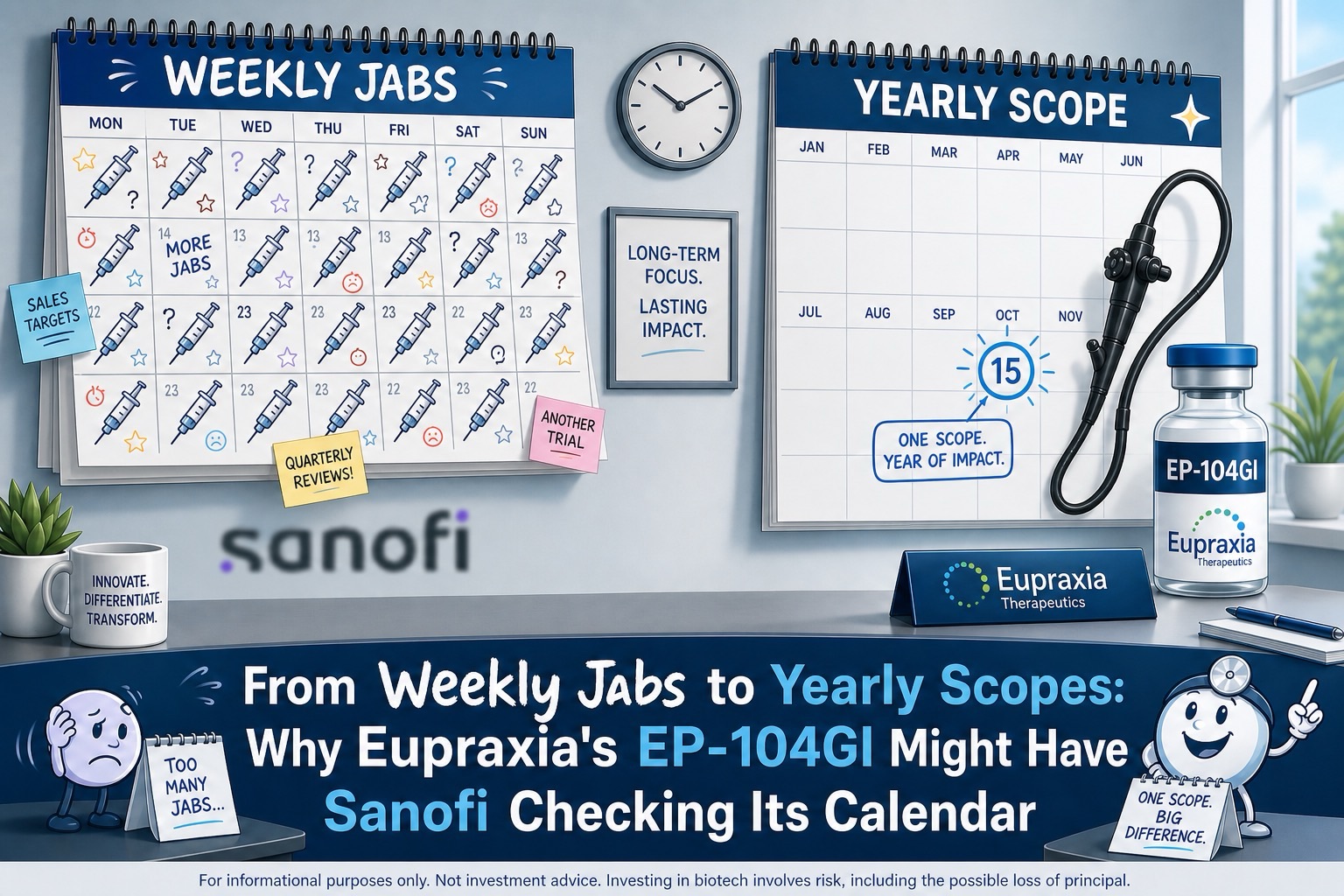
Eupraxia’s (NASDAQ: EPRX) latest data drop puts eosinophilic esophagitis (EoE) firmly at center stage, with fresh endoscopic and long‑term clinical results suggesting EP‑104GI could emerge as a once‑yearly, procedure‑based alternative to chronic biologic regimens such as Sanofi’s (SNY) multi-billion dollar weekly-injectable drug Dupixent—especially for patients and payers who care about durability, adherence, and local delivery.
EoE Takes the Lead Role
Eupraxia is steadily defining itself as a precision‑delivery company for chronic inflammatory disease, and nowhere is that clearer than in EoE. EP‑104GI is built on a straightforward but powerful proposition: deliver fluticasone directly into the esophageal wall, keep it there with diffusion‑controlled release, and minimize systemic exposure that usually accompanies long‑term steroid or biologic therapy.
Instead of daily swallowed steroids or weekly biologic injections, EP‑104GI is designed as a one‑time set of targeted esophageal wall injections administered during endoscopy, with effects that can extend toward a year in higher‑dose cohorts. That turns the typical EoE treatment paradigm on its head, swapping constant adherence demands for a scheduled, procedure‑based approach that fits naturally into the way gastroenterologists already manage moderate‑to‑severe disease.
What the New EREFS Data Show
The latest RESOLVE update focuses on the Eosinophilic Esophagitis Endoscopic Reference Score (EREFS), the standardized system that grades the visual hallmarks of EoE—rings, furrows, exudates, edema, and strictures—seen during endoscopy. EREFS matters because it converts what the endoscopist sees into a reproducible score that tracks both inflammatory and fibrotic components of the disease over time.pubmed.ncbi.nlm.nih+1
In today’s dataset, patients who received the full “20‑injection” EP‑104GI protocol, with broad coverage along the esophagus, showed more pronounced and consistent improvements in EREFS than those treated with fewer injections and less coverage. The pattern is intuitive but important: the more thoroughly the esophageal wall was treated, the greater the improvement across both inflammatory and fibrotic subscores, reinforcing the logic of EP‑104GI as a coverage‑driven, localized therapy.
Converging Signals: Symptoms, Histology, and Now Endoscopy
The EREFS readout doesn’t exist in a vacuum; it builds on earlier RESOLVE data showing strong and durable improvements in symptoms and tissue histology. Prior high‑dose cohorts reported meaningful and sustained clinical remission rates on the Straumann Dysphagia Index at 12, 24, 36, and even 52 weeks after a single EP‑104GI administration, with two‑thirds of patients in one cohort remaining in clinical remission at one year.
On the tissue level, the same program has demonstrated large, sustained reductions in eosinophil burden and meaningful improvements in EoE Histology Scoring System (EoEHSS) grade and stage, indicating both less severe and less extensive disease. With EREFS now improving in parallel, EP‑104GI is delivering aligned signals across symptoms, histology, and endoscopy—exactly the kind of multidimensional story regulators, clinicians, and payers look for in a chronic inflammatory indication.
A Procedure‑Based, Precision‑Delivery Model
EP‑104GI’s esophageal wall injection approach might sound bold at first pass, but it slots neatly into existing EoE practice patterns, where patients often undergo periodic endoscopy for diagnosis, monitoring, and dilation. RESOLVE’s Phase 1b/2a portion has systematically varied both the number of injections (coverage) and the dose per site to define how much localized exposure is needed to achieve robust, durable responses.
Because EP‑104GI uses Eupraxia’s Diffusphere technology to keep drug levels locally therapeutic over extended periods, the intent is to convert a single endoscopy visit into months—potentially a year—of disease control. For patients, that means less daily burden; for physicians, it means turning a familiar procedure into a high‑impact intervention; for payers, it raises the prospect of replacing continuous chronic dosing with episodic, high‑value events.
Safety Profile: Local Punch, Systemic Restraint
To date, the safety profile of EP‑104GI has remained a key asset. Across Phase 1b/2a experience, Eupraxia has reported no drug‑related serious adverse events, no clinically meaningful adrenal suppression, and no steroid‑driven glucose abnormalities, despite potent local exposure. Importantly, the procedure‑based local delivery has not produced oropharyngeal candidiasis, a common nuisance with swallowed topical steroids that coat the mouth and throat before reaching the esophagus.
This stands in contrast to systemic biologic approaches, which, while effective, necessarily expose the entire immune system to long‑term modulation. For a chronic condition often diagnosed in younger patients who may need treatment for decades, the prospect of a localized, extended‑release therapy with a clean systemic footprint is strategically and clinically attractive.
How EP‑104GI Appears to Differ from Sanofi’s Dupixent
Sanofi’s Dupixent (dupilumab) has reshaped the EoE landscape as the first approved biologic, delivering robust, sustained improvements in histology, symptoms, and endoscopic findings over 52 weeks with weekly 300 mg subcutaneous dosing. In long‑term studies, roughly 80–85% of patients on weekly Dupixent achieved histologic remission, with significant reductions in dysphagia scores and favorable overall tolerability, albeit with injection‑site reactions and conjunctivitis among the more common adverse events.
EP‑104GI is not trying to beat Dupixent at its own game; it is playing a different one. Early‑ and mid‑stage data suggest several potential advantages, while acknowledging that no head‑to‑head trials exist and cross‑trial comparisons are inherently imperfect:
- Dosing burden and adherence:
- Dupixent requires ongoing weekly injections at a relatively high systemic dose for EoE, a higher‑frequency regimen than in some of its other indications.
- EP‑104GI aims for once‑per‑year dosing via a single endoscopy session, with cohorts showing maintained symptom and tissue benefits out to 52 weeks after one administration in early studies.
- Local vs systemic exposure:
- Dupixent is a systemic IL‑4/IL‑13 pathway blocker, modulating immune responses throughout the body; this supports broad efficacy but entails long‑term systemic immunomodulation.
- EP‑104GI delivers fluticasone directly into the esophageal wall, with pharmacokinetic data and safety signals so far consistent with localized exposure and minimal systemic steroid effects.
- Mode of delivery and patient fit:
- Dupixent is self‑administered by regular subcutaneous injection, which is convenient for some but places adherence squarely on the patient over years.
- EP‑104GI is administered by a specialist during a planned endoscopy, aligning treatment with existing procedural workflows and potentially appealing to patients who prefer a “set it and forget it” annual intervention.
- Potential economic and operational considerations:
- Biologics like Dupixent are premium‑priced chronic therapies, with cost and payer management considerations that scale with years of weekly dosing..
- EP‑104GI’s value proposition leans on durability and reduced dosing frequency—concentrating cost and logistics into episodic care that may be easier to model for certain health systems, particularly if once‑yearly control is confirmed in larger studies.
In effect, Dupixent has set a high efficacy bar for chronic systemic control, while EP‑104GI is positioning itself as a localized, procedure‑based, long‑acting alternative that could be attractive on adherence, systemic exposure, and potentially cost structure if late‑stage data replicate the early signals.
From Early Mapping to Controlled Testing
The early RESOLVE cohorts have focused on mapping the EP‑104GI dose–coverage landscape: how many injections, what per‑site dose, and how much esophageal coverage is necessary for optimal, durable response. The emerging message is that higher total doses with full esophageal coverage yield stronger, more consistent improvements across symptoms, histology, and EREFS.
With those lessons in hand, Eupraxia has moved into a randomized, placebo‑controlled Phase 2b portion of RESOLVE, enrolling patients at 120 mg and higher coverage regimens that appeared most promising in Phase 1b/2a. Top‑line data from this Phase 2b segment are expected in 2026, setting a clear timeline for investors and clinicians to see whether EP‑104GI’s once‑yearly ambition holds up in a more rigorous comparative framework.
Why This Matters for the EoE Landscape
EoE has evolved from a niche diagnosis to a growing chronic market crowded with swallowed steroids, diet strategies, and now biologics like Dupixent, alongside newer entrants such as Eohilia and Jorveza. What remains unmet is a solution that meaningfully reduces day‑to‑day treatment burden while controlling both inflammatory and fibrotic components of disease over the long term.
EP‑104GI’s story is tailored for that gap: long‑acting, local, procedure‑based therapy that lines up symptom relief, tissue healing, and endoscopic improvement, with early safety data that lack systemic steroid red flags. As biologics like Dupixent establish the standard for systemic control, EP‑104GI is working to define a complementary or alternative lane where less frequent, locally delivered therapy can compete on durability, adherence, and overall treatment experience.
If upcoming randomized data confirm what early RESOLVE cohorts and the new EREFS readout suggest, EoE could become the indication that not only showcases Eupraxia’s Diffusphere platform but also offers a differentiated counterpoint to chronic biologic regimens—one annual scope at a time.
The Sources
- Eupraxia Pharmaceuticals – EREFS data from Phase 1b/2a RESOLVE trial in EoE (DDW 2026)biospace
https://www.biospace.com/press-releases/eupraxia-pharmaceuticals-reports-erefs-data-from-its-ongoing-phase-1b-2a-resolve-trial-in-eosinophilic-esophagitis-at-digestive-disease-week-ddw - StockTitan – Eupraxia EoE data: 65% EREFS drop at 20 injections (RESOLVE endoscopy update)stocktitan
https://www.stocktitan.net/news/EPRX/eupraxia-pharmaceuticals-reports-erefs-data-from-its-ongoing-phase-fqg1knrcu896.html - Investing.com – Eupraxia reports endoscopy score data from EoE trial (EREFS news)investing
https://www.investing.com/news/company-news/eupraxia-reports-endoscopy-score-data-from-eoe-trial-93CH-4658552 - BioSpace – First set of 1‑year clinical results from RESOLVE trial in EoE (52‑week EP‑104GI data)biospace
https://www.biospace.com/press-releases/first-set-of-1-year-clinical-results-from-resolve-trial-in-eosinophilic-esophagitis-eoe - ClinicalTrialVanguard – Eupraxia’s EoE drug delivers consistent results at 52 weeks (RESOLVE durability summary)clinicaltrialvanguard
https://www.clinicaltrialvanguard.com/news/eupraxias-eoe-drug-delivers-consistent-results-at-52-weeks - Patient Worthy – EP‑104GI performs well in eosinophilic esophagitis (overview of Diffusphere approach and RESOLVE)patientworthy
https://patientworthy.com/2024/06/11/ep104gi-performs-well-eosinophilic-esophagitis-eoe-trial - Patsnap Synapse – Eupraxia Pharma reports RESOLVE trial data on EP‑104GI for EoE (early cohort outcomes)synapse.patsnap
https://synapse.patsnap.com/article/eupraxia-pharma-reports-resolve-trial-data-on-ep-104gi-for-eosinophilic-esophagitis - Eupraxia corporate materials – DDW / ISDE EP‑104GI RESOLVE posters (study design, dose‑escalation, PK and efficacy)eupraxiapharmaceuticals+1
https://www.eupraxiapharmaceuticals.com/wp-content/uploads/2025/08/DDW2025_RESOLVE-e-poster_FINAL.pdf
https://www.eupraxiapharmaceuticals.com/wp-content/uploads/2025/08/2024_09_10_ISDE-2024-EoE-poster_FINAL.pdf - Clinical trial listing – RESOLVE Phase 1b/2 study of EP‑104GI in adults with EoE (design and endpoints, including EREFS)ctv.veeva+1
https://ctv.veeva.com/study/a-trial-evaluating-ep-104iar-in-adults-with-eosinophilic-esophagitis
https://clinicaltrial.be/nl/details/268026 - Yahoo Finance – Eupraxia to present at Digestive Disease Week (preview of EoE endoscopic and fibrosis data)finance.yahoo
https://finance.yahoo.com/sectors/healthcare/articles/eupraxia-pharmaceuticals-present-digestive-disease-110000292.html - Sanofi / Dupixent HCP site – Efficacy, safety, and long‑term outcomes of Dupixent in EoE (clinical, histologic, endoscopic endpoints up to 52 weeks)dupixenthcp
https://www.dupixenthcp.com/eoe/efficacy-safety/efficacy - VA Monograph – Dupilumab (Dupixent) in EoE: dosing, safety and formulary considerationsva
https://www.va.gov/formularyadvisor/DOC_PDF/MON_Dupilumab_DUPIXENT_in_Eosinophilic_Esophagitis_Monograph_Nov_2022.pdf - Peer‑reviewed literature – Efficacy and safety of dupilumab up to 52 weeks in EoE (adults and adolescents)pmc.ncbi.nlm.nih+1
https://pmc.ncbi.nlm.nih.gov/articles/PMC11857325
https://pubmed.ncbi.nlm.nih.gov/37660704 - Sanofi press release – Dupixent Phase 3 results show sustained efficacy up to one year in pediatric EoEnews.sanofi
https://www.news.sanofi.us/2023-10-22-Dupixent-R-dupilumab-Phase-3-Results-show-sustained-efficacy-for-up-to-one-year-in-children - Market and treatment‑landscape overviews – New treatments and EoE market projections (Eohilia, Jorveza, market size)allergylosangeles+2
https://allergylosangeles.com/allergy-blog/new-treatments-for-eosinophilic-esophagitis-eoe
https://www.delveinsight.com/insights/eosinophilic-esophagitis-market-size
https://clinicaltrials.gov/study/NCT07358234
Stay Updated with Vista Partners
Subscribe to receive market insights, investing ideas, and the latest updates directly in your inbox.