Bill Ackman’s Pershing Square has turned a tidy $6.4 billion in gains into more than a victory lap; it has become a live case study in how a concentrated portfolio, a flair for macro hedges, and a very public persona can compound both capital and brand value. Now, with a reported headline‑grabbing $64 billion bid for Taylor Swift’s label, Universal Music Group, the firm is signaling that its appetite for scale—and for owning the cultural soundtrack as well as the balance sheet—is very much intact.
The $6.4 Billion Calling Card
In recent years, Pershing Square has quietly rebuilt its reputation from post‑setback skepticism to front‑page envy. Strong double‑digit annualized returns, capped by roughly $6.4 billion in gains for investors, have re‑anchored Ackman’s status as one of the few managers still consistently beating broad equity benchmarks over long stretches.
That figure is not just a number; it is an advertisement. It underpins Pershing Square’s push to scale into a listed asset‑management franchise, positioning the firm as more than a hedge fund and closer to a permanent‑capital compounding machine. For investors, the message is simple: the past few years have not just been good—they have been franchise‑defining.
How Pershing Square Made Its Comeback
The comeback was not built on a sprawling book of small ideas; it was engineered through a sharper, narrower approach. Pershing Square reduced the portfolio to a compact set of businesses with visible cash flows, durable competitive advantages, and long runways for reinvestment. The firm then layered in selective, high‑payoff macro hedges that turned market stress into opportunity.
The most famous example remains the pandemic‑era credit hedge that turned tens of millions into billions, followed by a well‑timed bet on rising interest rates. Those trades did more than protect capital—they created fresh ammunition just when markets were most dislocated. Add in strong stock selection, and the result has been a blend of crisis‑era windfalls and bull‑market compounding that few peers have matched.
Inside the Pershing Square Playbook
At the heart of this story is the portfolio itself: a deliberately short list of big, liquid, mostly large‑cap names. Pershing Square typically holds only a handful of core positions, with the top four or five names often accounting for the majority of capital. In other words, this is not diversification; this is concentration with a conviction label.
The current roster centers on eight flagship positions that carry most of the narrative weight:
- Brookfield Corporation (BN) – A dominant alternative‑asset and infrastructure platform, giving Pershing Square leveraged exposure to real assets, renewables, and private equity‑style economics.
- Uber Technologies (UBER) – A global mobility and logistics network where Ackman is effectively betting that ride‑sharing and delivery will mature into stable, cash‑rich businesses rather than perpetually subsidized experiments.
- Amazon.com (AMZN) – The ultimate long‑duration compounder, spanning e‑commerce, logistics, and a high‑margin cloud franchise that anchors Pershing Square’s bet on digital infrastructure.
- Alphabet (GOOGL/GOOG) – A core position tying the fund to digital advertising, search, YouTube, and cloud, all wrapped in one of the strongest balance sheets in global markets.
- Meta Platforms (META) – A cash‑gushing social‑media and attention‑economy giant, where scale, engagement, and a robust repurchase engine combine into a capital‑return story with algorithmic reach.
- Universal Music Group (UMG) – A global music rights powerhouse, offering a royalty‑driven, asset‑light way to participate in the streaming and catalog‑valuation boom.
- Restaurant Brands International (QSR) – The owner of marquee quick‑service chains, providing a global franchise and royalty model that compounds through refranchising and international expansion.
- Howard Hughes Holdings (HHH) – A long‑standing real‑asset and development platform, emblematic of Ackman’s roots in activism and his willingness to wait years for value creation to show up in the share price.
These eight names function more like strategic stakes than ordinary holdings. Pershing Square’s history of activism means management teams know there is a capable, occasionally vocal shareholder on the register—even when today’s playbook leans more toward collaboration than confrontation.
The $64 Billion UMG Gambit
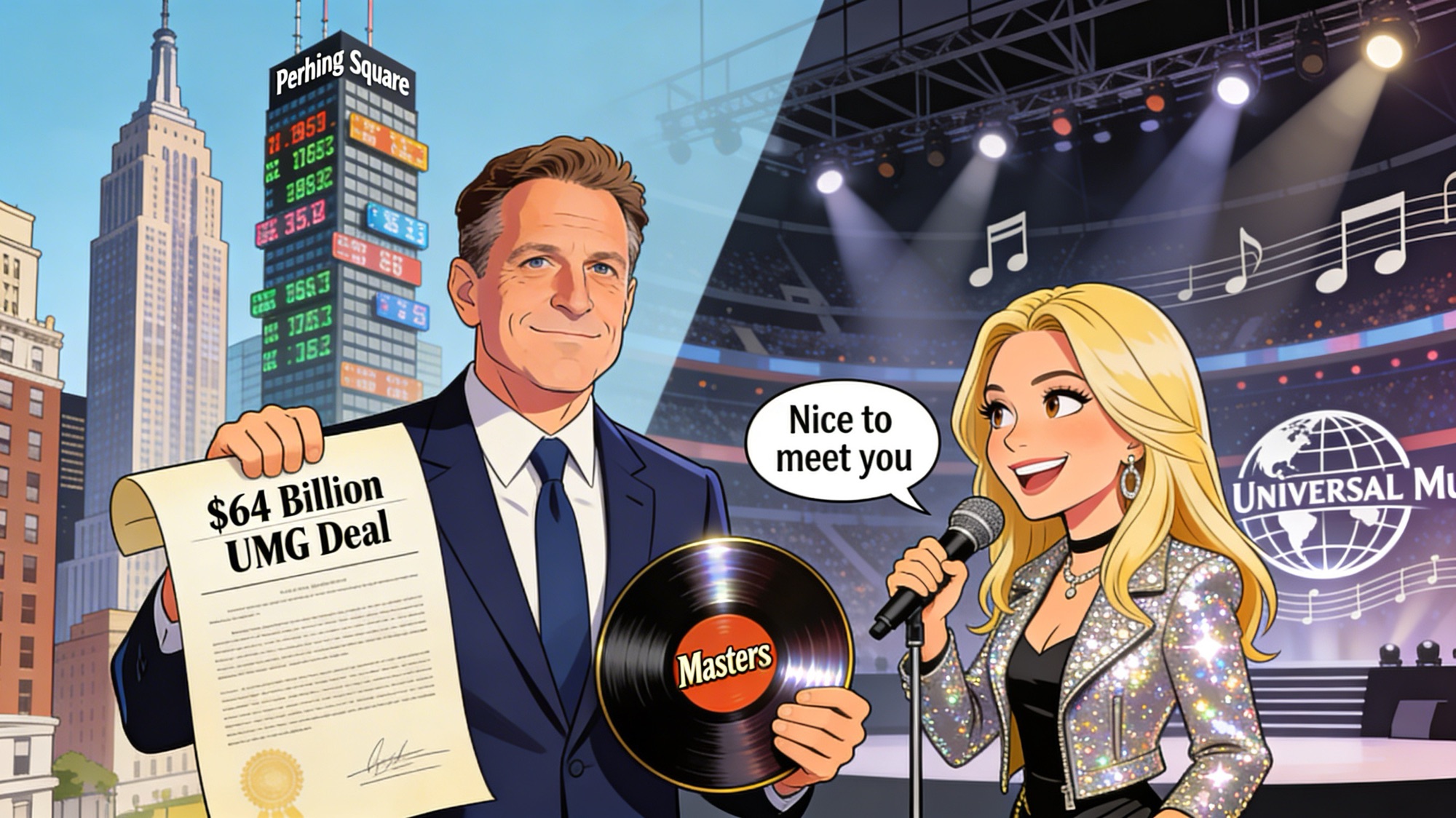
Against this backdrop, Pershing Square’s $64 billion bid for Universal Music Group, Taylor Swift’s label, lands as both a logical extension and a bold escalation. UMG is already one of the firm’s flagship positions, and moving from influential shareholder to aspiring owner of the entire platform would transform a successful investment into a defining corporate bet.
Strategically, the move would give Pershing Square direct control over one of the world’s most valuable catalogs, locking in exposure to streaming‑driven cash flows, catalog re‑ratings, and the economics of global pop culture—Swift very much included. Financially, a $64 billion offer signals confidence not only in the durability of music royalties but in Pershing Square’s ability to finance, structure, and manage one of the largest entertainment deals in recent memory.
For investors, the humor writes itself: the same manager known for precision hedges and concentrated industrial bets is now effectively trying to own part of the playlist to their daily commute. Yet beneath the sophisticated punchline is a consistent through‑line—Pershing Square likes businesses with recurring revenue, pricing power, and global reach, and UMG checks every box while humming a chart‑topping soundtrack.
From Hedge Fund to Listed Franchise
The performance and the portfolio have set the stage for Pershing Square’s next act: turning a successful fund into a scaled, fee‑rich public company. Private transactions valuing the management business in the double‑digit billions, and moves toward listing both Pershing Square’s management entity and a new U.S. vehicle, effectively convert investment skill into a durable earnings stream.
This shift also changes the way the market values Ackman himself. The question is no longer just whether he can pick the next winner; it is how much a global, brand‑name alternatives platform attached to his track record is worth. The $6.4 billion headline, the tight roster of eight marquee holdings, and a $64 billion swing at Universal Music Group all make that sales pitch easier to deliver—whether to institutional allocators or to retail investors who can finally buy the manager, not just the managed assets.
What It Means for Investors
For allocators watching from the sidelines, Pershing Square’s evolution sends several clear signals:
- Concentration still works when paired with genuine research depth and a willingness to be meaningfully wrong in pursuit of being meaningfully right.
- Macro hedges can be assets, not distractions, if deployed sparingly and sized to matter, rather than as cosmetic overlays.
- Brand and access are part of the return equation, especially when a manager’s track record feeds into a public‑company multiple, incremental fee streams, and the occasional bid to own the label behind the world’s biggest pop star.
In short, Pershing Square has managed to turn a compact list of eight modern blue‑chip bets and a handful of well‑timed hedges into billions in investor gains—and then used those gains as the foundation for increasingly ambitious corporate moves. For investors, the story is no longer just about which stock Ackman buys next, but about how far a concentrated, highly visible franchise can scale when it is willing to reach from Wall Street’s canyons all the way to the top of the charts.
The Sources
- Pershing Square Capital Management, L.P. Portfolio Holdings – Fintel
https://fintel.io/i/pershing-square-capital-management[1] - Pershing Square Capital Management Portfolio | Bill Ackman 13F – HedgeFollow
https://hedgefollow.com/funds/Pershing+Square+Capital+Management[2] - Positioned for 2026: Ackman Doubles Down on Long-Duration Compounders – Acquirer’s Multiple
https://acquirersmultiple.com/2025/12/bill-ackman-positioned-for-2026-ackman-doubles-down-on-long-duration-compounders/[3] - Pershing Square Capital Management, L.P. – WhaleWisdom
https://whalewisdom.com/filer/pershing-square-capital-management-l-p[4] - Pershing Square Capital Management L.P. Top Holdings 13F Filings – HoldingsChannel
https://www.holdingschannel.com/13f/pershing-square-capital-management-l-p-top-holdings/[5] - Bill Ackman’s Portfolio: 8 Stocks He’s Betting Big On in 2025 – TIKR Blog
https://www.tikr.com/blog/bill-ackmans-portfolio-8-stocks-hes-betting-big-on-in-2025[6] - Here’s What Hedge Funds Bought in Q4 2025 – HedgeVision (Substack)
https://hedgevision.substack.com/p/heres-what-hedge-funds-bought-in-a27[7] - Pershing Square’s 2026 Crisis: How 46.5% Concentration in Four Stocks… – Capital Blueprint (Substack)
https://capitalblueprint.substack.com/p/pershing-squares-2026-crisis-how[8] - Portfolio Company Holdings – Pershing Square Holdings
https://pershingsquareholdings.com/portfolio/[9] - Bill Ackman Portfolio: Q4 2025 Picks, Holdings & Trends – 13Radar
https://www.13radar.com/guru/bill-ackman[10] - Pershing Square Holdings (PSH) – Feb 2026 | Investor
https://www.trustintelligence.co.uk/investor/articles/fund-research-investor-pershing-square-holdings-psh-retail-feb-2026[11] - Tracking Bill Ackman’s Pershing Square 13F Portfolio – Q4 2025 – Seeking Alpha
https://seekingalpha.com/article/4880842-bill-ackman-pershing-square-13f-portfolio-q4-2025-update[12] - Bill Ackman Portfolio: Top Holdings February 2026 – Stockcircle
https://stockcircle.com/portfolio/bill-ackman/news/bill-ackman-portfolio-top-holdings-february-2026[13]
Stay Updated with Vista Partners
Subscribe to receive market insights, investing ideas, and the latest updates directly in your inbox.