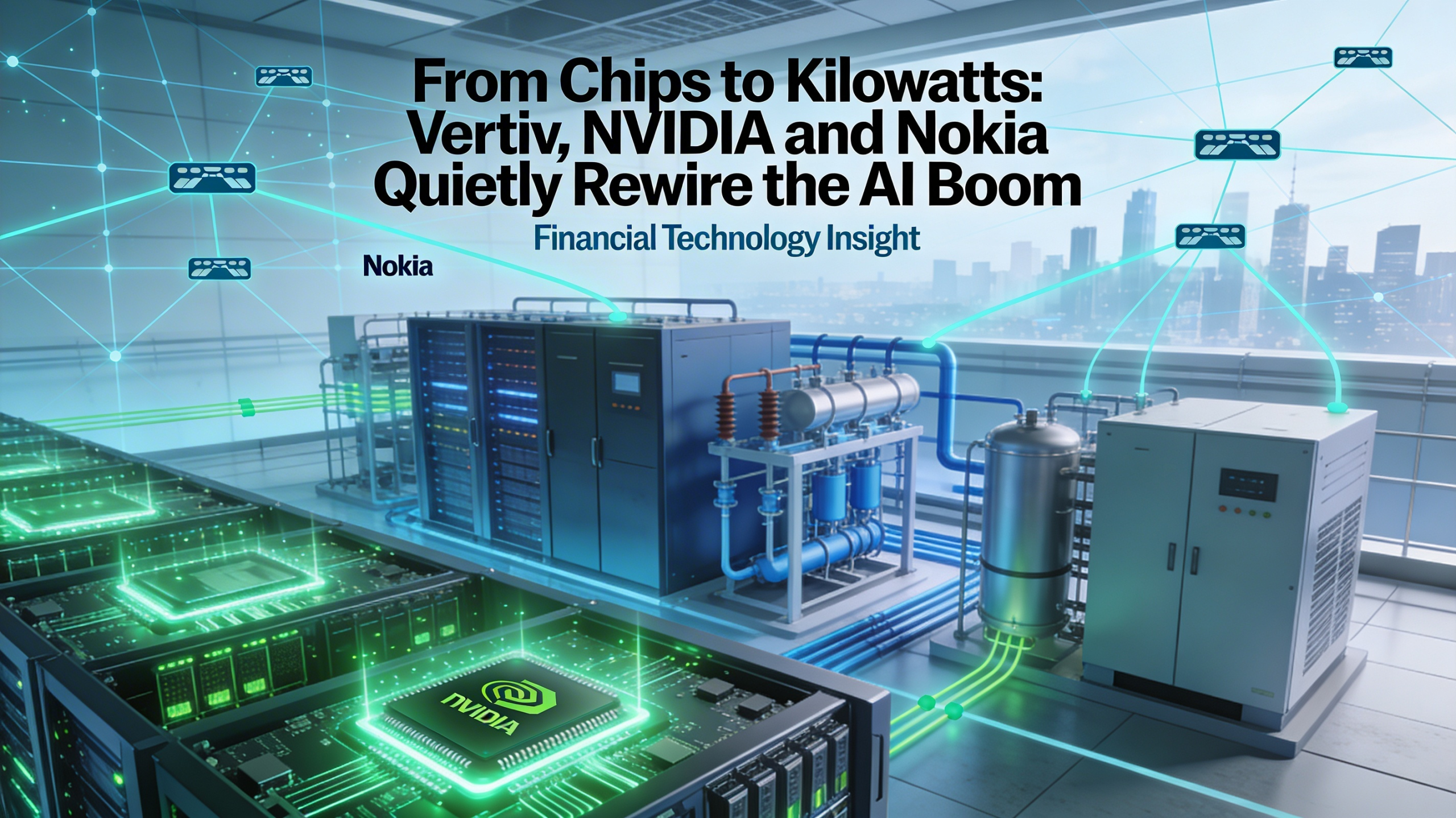
Vertiv’s (VRT) latest move reads like a front‑page Wall Street story for the AI era: a power-and-cooling heavyweight teaming with a deep‑pocketed infrastructure investor to keep NVIDIA‑class data centers humming in markets where the grid is already wheezing.
Vertiv, Generate Capital and the Race to Power AI
Vertiv and Generate Capital have announced a strategic collaboration to deliver “bring your own power and cooling” solutions that help data center operators deploy capacity faster in power‑constrained regions across the U.S. The model blends Vertiv’s modular power and thermal infrastructure with Generate’s project financing, asset ownership and long‑term operations, aiming to shorten time to operation while easing upfront capex.
Instead of simply selling equipment, Vertiv is effectively graduating into co‑designer and co‑owner of AI‑ready capacity, positioning itself higher in the data center value chain. Initial deployments may tap reciprocating engines, turbines, fuel cells, integrated cooling and battery storage to deliver on‑site power today, with the flexibility to transition to utility power as grid capacity catches up later. For hyperscalers on NVIDIA GPU shopping sprees, it is a bit like having an on‑call electrician, plumber and project financier rolled into one.
NVIDIA’s AI Factories Turn Heat into a Headline Risk
NVIDIA’s (NVDA) Blackwell‑based GB200 NVL72 and successors push compute density to levels at which conventional air‑cooled designs start to look nostalgic, if not reckless. Liquid‑cooled GB200 NVL72 systems offer up to 40x higher revenue potential, 30x higher throughput, 25x greater energy efficiency and 300x better water efficiency versus traditional air‑cooled architectures, but they require equally advanced thermal and power ecosystems around them.
At nearly 1,000x the density of air, liquid‑cooling fluids can carry away the intense thermal loads generated by high‑performance GPUs far more efficiently, enabling warmer water temperatures and reducing reliance on mechanical chillers. Vertiv, for its part, has reference architectures for NVIDIA GB200 NVL72 racks that can cut annual energy consumption by 25%, trim rack space needs by 75% and shrink power footprints by 30%—the sort of numbers that make both sustainability officers and CFOs nod approvingly. Pair that with Generate’s capital and the industry gets something rare in data centers: an elegant solution to both physics and financing.
Nokia’s Efficient Networks: Trimming the AI Power Tab
If Vertiv and Generate are helping build the AI factory floor, Nokia (NOK) is busy rewiring the aisles and exits so that every bit travels efficiently from chip to cloud. Nokia supplies networking inside and between data centers as well as from users to applications, and it has highlighted optical networking advances that can lower network power consumption by about 60% per bit even as traffic is expected to grow 18%–27% annually through 2033.
Nokia’s own data center in Finland already recycles waste heat to warm roughly 14,000 homes, underscoring how smarter design can make AI infrastructure a net contributor to local energy systems. Bell Labs research into smaller, domain‑specific language models also points to AI that does more with less power, complementing NVIDIA’s hardware efficiency and Vertiv’s thermal gains with software‑driven frugality on the network side. In boardrooms, that combination increasingly sounds like the holy trinity of AI build‑outs: performance, latency and a power bill that doesn’t read like a sovereign‑debt prospectus.
Grid Constraints Meet Capital Innovation
Behind the elegance, there is a hard constraint: grid access. Studies backed by the U.S. Energy Department suggest American data center power demand could triple in the next three years, forcing operators to look beyond traditional utility timelines and interconnect queues. Vertiv and Generate’s collaboration is designed specifically to address delays in grid connections and infrastructure bottlenecks, synchronizing technology deployment and project financing so new capacity can come online months or even years sooner.
Generate is prepared to own assets and fund initial infrastructure, giving operators a way to conserve capital while moving aggressively on AI capacity—particularly useful in markets where NVIDIA‑class systems are sold out long before the substations are ready. Customers can start with on‑site generation, battery storage and pre‑engineered cooling, then pivot toward cleaner grid power or renewables as they become available, effectively treating the grid as an optional subscription rather than a prerequisite.
A New AI Infrastructure Playbook
Taken together, NVIDIA’s AI factories, Vertiv’s power‑and‑cooling platforms, Generate’s capital and Nokia’s efficient networks sketch a new AI infrastructure playbook built around density, efficiency and financial creativity. Data centers no longer resemble simple rows of servers; they are evolving into tightly integrated, liquid‑cooled, high‑voltage “AI plants” that demand as much attention to thermodynamics and capital structure as to FLOPs per second.
For investors, the story is not just about chipmakers; it is about the ecosystem of companies making sure those chips have power, cooling, bandwidth and capital exactly when and where they are needed. For policy makers and communities, the emerging model—where waste heat warms homes and off‑grid power keeps AI running without overwhelming local utilities—offers an early glimpse of how the AI boom might be squared with climate and infrastructure realities.
The Sources
- Vertiv and Generate Capital collaborate to accelerate data center capacity
https://finance.yahoo.com/news/vertiv-generate-capital-collaborate-accelerate-130000611.html[finance.yahoo] - Vertiv and Generate Capital collaborate to accelerate data center capacity (Vertiv corporate site)
https://www.vertiv.com/en-us/about/news-and-insights/corporate-news/2026/vertiv-and-generate-capital-collaborate-to-accelerate-data-center-capacity/[vertiv] - Vertiv partnership with Generate Capital reframes power constraints in AI data centers
https://finance.yahoo.com/news/vertiv-partnership-generate-capital-reframes-190649471.html[finance.yahoo] - Vertiv joins S&P 500 as AI data center story expands
https://finance.yahoo.com/news/vertiv-joins-p-500-ai-190734537.html[finance.yahoo] - Vertiv Holdings Co (VRT) is up after new AI platform launch
https://finance.yahoo.com/news/vertiv-holdings-co-vrt-5-061258934.html[finance.yahoo] - NVIDIA Blackwell platform boosts water efficiency by over 300x
https://blogs.nvidia.com/blog/blackwell-platform-water-efficiency-liquid-cooling-data-centers-ai-factories/[blogs.nvidia] - NVIDIA Blackwell platform slashes water use by 300x
https://getcoai.com/news/nvidia-blackwell-platform-slashes-water-use-by-300x/[getcoai] - Nokia blog: Powering the AI era – why energy efficiency defines the future of data center networking
https://www.nokia.com/blog/powering-the-ai-era-why-energy-efficiency-defines-the-future-of-data-center-networking/[nokia] - Nokia CEO: Making AI greener starts with smarter data center design
https://fortune.com/2025/01/17/ai-data-centers-energy-efficiency-nokia-ceo/[fortune] - Nokia press release: Nokia strengthens AI data center performance and AI-enabled automation with enhanced portfolio
https://www.nokia.com/newsroom/nokia-strengthens-ai-data-center-performance-and-ai-enabled-automation-with-enhanced-portfolio/[nokia]
Stay Updated with Vista Partners
Subscribe to receive market insights, investing ideas, and the latest updates directly in your inbox.