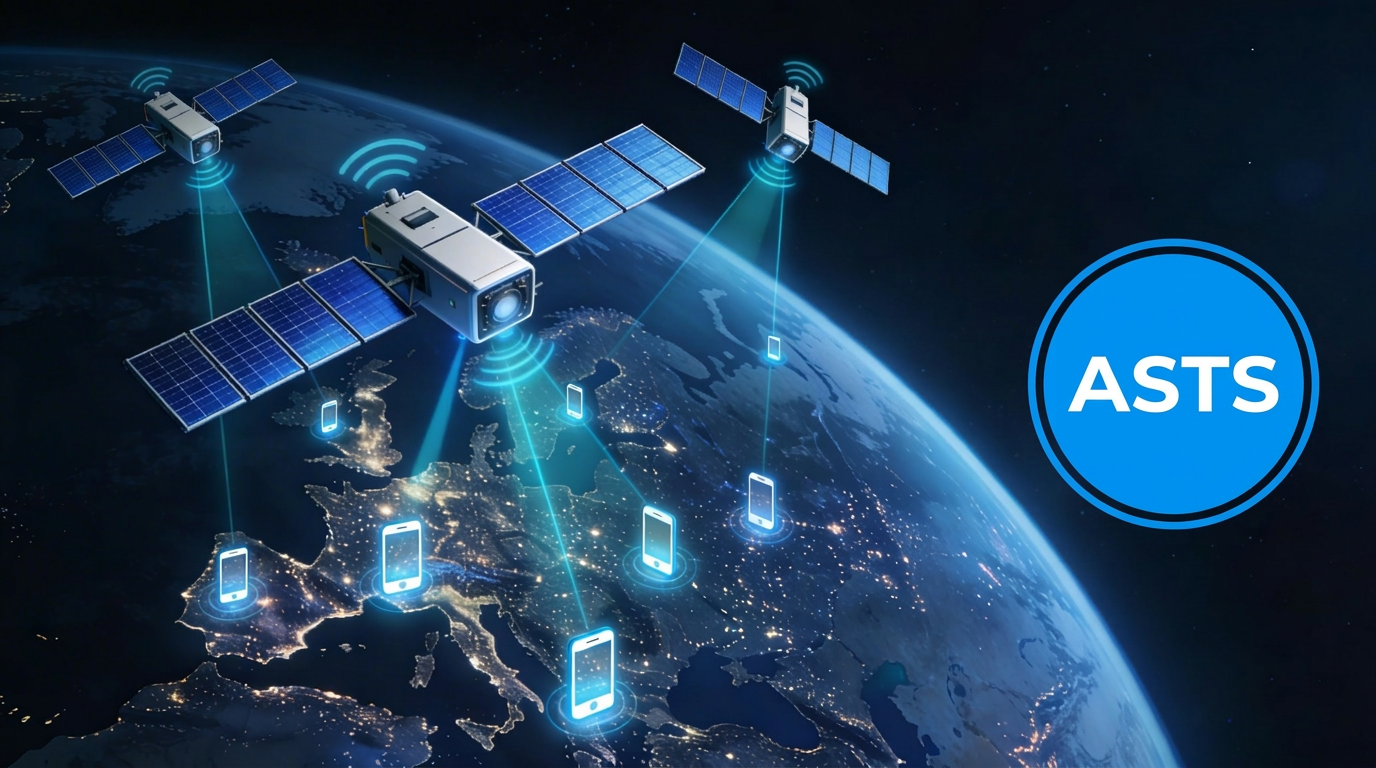
AST SpaceMobile (ASTS) is turning its long‑promised “cell tower in space” vision into a real, revenue‑generating business, and investors are finally getting numbers big enough to circle on a calendar instead of sketch on a napkin.
AST SpaceMobile’s First Big Leap: Revenue Arrives
AST SpaceMobile reported its first full year of meaningful revenue in 2025, delivering approximately 70.9 million dollars, at the high end of its guidance range. That top line is driven largely by two engines: mobile network operator (MNO) partners and the U.S. Government, a pairing that would make most telecom CFOs nod approvingly.
Product revenue has begun to scale as AST SpaceMobile shipped 15 gateway sites across five continents, effectively seeding the ground segment for its space‑based cellular network. On the services side, multiple U.S. Government contracts are already producing revenue as agencies test specialized use cases for the company’s direct‑to‑device architecture.
Building a Constellation, Not Just a Story
If 2023 and 2024 were about proving the physics, 2025 and 2026 are about proving the factory. AST SpaceMobile expects to complete assembly of roughly 40 satellites by the first half of 2026, supported by a newly acquired fourth production site in Midland, Texas that brings its global manufacturing footprint above 500,000 square feet.
The company is targeting 45 to 60 BlueBird satellites in orbit by the end of 2026, with launches planned roughly every one to two months, a cadence that sounds more like a software release schedule than a space program. Each BlueBird is designed from day one for direct‑to‑device connectivity, using large phased‑array antennas to talk to standard smartphones without requiring specialty hardware on the ground.
From MOU Theater to Multi‑Billion Commitments
AST SpaceMobile’s commercial book of business is starting to look less like an aspiration deck and more like a telecom contract binder. The company has now lined up agreements with roughly 50 mobile network operators worldwide, together representing nearly 3 billion existing subscribers.,
Those signatures come with actual dollars attached: AST SpaceMobile has secured more than 1.2 billion dollars in aggregate contracted revenue commitments, including a 175 million dollar commercial prepayment from stc Group as part of a 10‑year regional agreement. Long‑dated commercial frameworks, such as Vodafone’s arrangement extending through 2034 across more than 20 countries, underscore that this is not a one‑off experiment but a decade‑long capacity plan.
Key commercial and strategic points include:
- A long‑term agreement with Vodafone (VOD) that runs through 2034 and spans more than 20 countries, reinforcing the view that satellite‑augmented coverage is becoming a mainstream part of the carrier toolkit rather than a novelty.finance.yahoo+1
- A 10‑year regional deal with stc Group, backed by a 175 million dollar prepayment, which effectively acts as both customer validation and working capital for the constellation build‑out.
- Partnerships with major U.S. carriers such as AT&T (T) and Verizon (VZ), where live video calls using the BlueWalker‑3 test satellite have already demonstrated that ordinary smartphones can connect directly to space.
- Early U.S. Government and allied‑market contracts that introduce dual‑use possibilities, from resilient communications in disasters to specialized government applications where terrestrial networks fall short.3
Financing the Space Cell Tower Build‑Out
If the revenue line is finally moving up and to the right, so too are the capital expenditures, a reminder that building a global satellite network is closer to constructing a nationwide fiber backbone than launching a mobile app. Capital spending surged to about 406.7 million dollars in the fourth quarter of 2025, up from 258.9 million dollars in the prior quarter, as the company ramped satellite production and related infrastructure.
AST SpaceMobile closed a sizable convertible notes offering and continues to tap its at‑the‑market equity program, leaving it with more than 3.9 billion dollars of pro forma liquidity—cash, equivalents, restricted cash, and available facilities—as of year‑end 2025. Management characterizes the structure as “minimally dilutive” and sufficient to fund the planned satellite deployment while moving toward initial commercial activation in 2026.
Operating expenses, unsurprisingly, remain elevated as the company scales engineering, gateway deliveries, and manufacturing, producing wider‑than‑expected quarterly losses despite strong revenue growth. Adjusted operating expenses, however, are being watched closely as a proxy for how quickly AST SpaceMobile can transition from heavy investment mode to a more familiar telecom‑like margin profile.
Looking to 2026: From Demos to Daily Usage
For 2026, AST SpaceMobile expects to at least double its 2025 revenue to roughly 150 million dollars, supported by its backlog of MNO commitments and U.S. Government milestones. Wall Street forecasts call for quarterly revenue on the order of 31.9 million dollars and 43.5 million dollars in the first and second quarters of 2026, respectively, paired with gradually improving but still negative earnings per share around minus 0.20.
The strategic objective is straightforward, even if the orbital mechanics are not: transform a series of headline‑grabbing test calls—like high‑profile video chats with Vodafone, AT&T and Verizon—into everyday roaming experiences for subscribers who never think about which cell tower is actually a satellite. If AST SpaceMobile executes on its launch cadence and commercial roadmap, “no‑coverage” zones could start looking more like historical footnotes than line items on a carrier’s customer‑complaint log, a development that both hikers and hedge funds are watching with interest.
Stay Updated with Vista Partners
Subscribe to receive market insights, investing ideas, and the latest updates directly in your inbox.