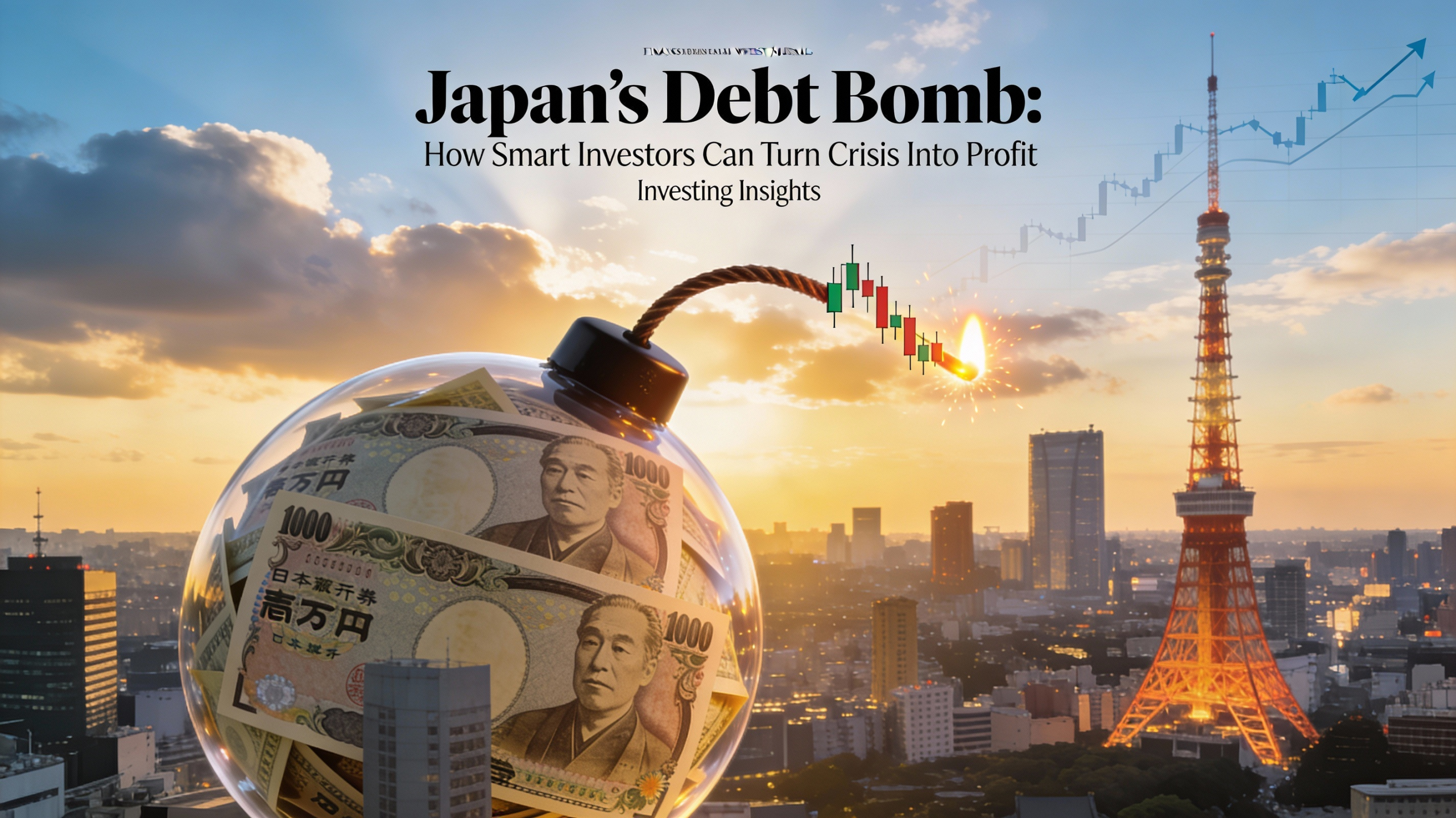
Japan’s towering debt load is finally colliding with rising interest rates, turning a decades‑old slow‑motion problem into something that looks uncomfortably like a fuse being lit—yet also creating one of the more intriguing global trades of the decade.
The World’s Biggest Debt Experiment
Japan’s government debt now hovers around roughly double its annual economic output, by far the highest among major advanced economies. For years, ultra‑low interest rates and aggressive bond buying by the Bank of Japan (BoJ) kept that burden strangely painless, like a mortgage with a 0% teaser rate that never reset.
That era is ending. Long‑term Japanese government bond (JGB) yields have surged as markets test how far the BoJ can go in relaxing its once‑rigid cap on yields without triggering a full‑blown funding scare. Inflation—once elusive—has stayed above the BoJ’s 2% target, forcing policymakers to tolerate higher yields and accept that the cost of financing that mountain of debt is drifting up.
Why the Debt “Bomb” Matters Now
The problem is not just size, but speed. When a government rolls over enormous amounts of debt, even modest increases in yields compound over time like a very unfriendly version of interest on your savings account. Japan’s super‑long bonds, once a sleepy niche for life insurers, suddenly trade like a thrill ride as investors demand more compensation for fiscal and inflation risk.
This volatility matters far beyond Tokyo. Japanese institutions are among the world’s biggest holders of foreign bonds; any shift away from overseas markets and back into higher‑yielding JGBs can rattle global yields from Treasuries to Italian BTPs. Think of it as the world’s largest carry trader reconsidering its life choices—all at once.
How Policy Makers Might Try to Defuse It
Officials are not exactly sitting on their hands while the market lights matches near the powder keg. The Ministry of Finance has already trimmed issuance of super‑long bonds, quietly acknowledging that investor appetite is not what it used to be. The BoJ, for its part, is juggling a gradual exit from yield‑curve control with the need to avoid a bond rout that would send funding costs sharply higher.
Some economists argue that Japan’s situation is less dire than the headline debt figures suggest because the state also owns substantial assets, from stakes in partially privatized firms to infrastructure and financial holdings. In theory, a well‑timed program of asset sales and continued moderate inflation could slowly shrink the real value of the debt—assuming markets grant Tokyo thepatience to execute it.
Where the Opportunities May Lie
For investors, the question is not whether Japan has a lot of debt—everyone already knows that—but how markets will reprice that reality as the old regime of pinned yields and a weak yen gives way to something more volatile. Several potential opportunity sets stand out, each with its own risk profile and time horizon.
- JGB volatility trades: Rising uncertainty over BoJ policy and fiscal sustainability has already increased swings in long‑dated JGBs, which can benefit investors positioned via options or volatility‑sensitive strategies rather than simple long or short bets.
- Stronger‑yen scenarios: If the BoJ tightens more forcefully or markets price in an end to yield‑curve control, the yen could appreciate as interest differentials narrow and Japanese investors repatriate capital.
- Global bond repricing: A structural shift in Japanese demand for foreign bonds—particularly in Europe and the U.S.—could create entry points in markets temporarily hit by selling from Japanese institutions.
Positioning to Profit—With Caution
There is no single “Japan debt bomb trade,” but rather a spectrum of ways to express a view on how the adjustment unfolds. Some global macro funds favor being long the yen against currencies where central banks are closer to cutting rates, on the thesis that policy divergence will narrow in Japan’s favor. Others focus on relative‑value trades across government bond markets, betting that JGB yields will move differently from U.S. or European benchmarks as Tokyo tries to fine‑tune issuance and the BoJ dances around market nerves. Also, if the U.S. dollars begins to suffer against the Yen, then that is typically good for gold and silver prices. i.e. ETF’s like GLD and SLV.
More patient investors may watch Japanese equities for opportunities in sectors that benefit from a stronger currency (via cheaper imports) or from higher domestic rates (via improved lending margins), while remaining wary of companies heavily exposed to rising government funding costs. In all cases, the key is risk management: this is less a quiet coupon‑clipping strategy and more an environment where stop‑losses, scenario analysis, and genuine time‑horizon discipline matter as much as the initial thesis.
The Sources
- St. Louis Fed – “Why Is Japan’s Government Debt So High?” https://www.stlouisfed.org/on-the-economy/2025/apr/what-is-behind-japan-high-government-debt[stlouisfed]
- Japan Ministry of Finance – FY2025 Public Finance Fact Sheet (PDF) https://www.mof.go.jp/english/policy/budget/budget/fy2025/02.pdf[mof.go]
- Trading Economics – “Japan General Government Gross Debt to GDP” https://tradingeconomics.com/japan/government-debt-to-gdp[tradingeconomics]
- BNP Paribas – “Japan: Decline in debt ratio based on fragile foundations” https://economic-research.bnpparibas.com/html/en-US/Japan-Decline-debt-ratio-based-fragile-foundations-11/19/2025,53030[economic-research.bnpparibas]
- Robin Brooks – “Japan in Crisis” https://robinjbrooks.substack.com/p/japan-in-crisis[robinjbrooks.substack]
- Bloomberg – “Japan Bond Crash Unleashes a $7 Trillion Risk for Global Markets” https://www.bloomberg.com/news/features/2026-01-25/japan-bond-market-crash-raises-alarm-for-global-interest-rates[bloomberg]
- Invesco – “Japan bond yields surge as fiscal risks rise” https://www.invesco.com/apac/en/institutional/insights/market-outlook/japan-bond-yields-surge-as-fiscal-risks-rise.html[invesco]
- BNP Paribas – “Japan: Yield curve out of control?” https://economic-research.bnpparibas.com/html/en-US/Japan-Yield-curve-control-11/6/2023,49065[economic-research.bnpparibas]
- U.S. News / Reuters – “Explainer: What Are Japan’s Policy Options to Soothe Its Bond Rout?” https://money.usnews.com/investing/news/articles/2026-01-22/explainer-what-are-japans-policy-options-to-soothe-its-bond-rout[money.usnews]
- Reuters – “Explainer: What are Japan’s policy options to soothe its bond rout?” https://www.investing.com/news/economy-news/explainerwhat-are-japans-policy-options-to-soothe-its-bond-rout-4459400[investing]
- Council on Foreign Relations – “The Japanese Bid for Foreign Bonds After the End of Yield Curve Control” https://www.cfr.org/articles/japanese-bid-foreign-bonds-after-end-yield-curve-control[cfr]
- RBC GAM – “The global implications for a shift in Japan’s yield curve control” https://institutional.rbcgam.com/en/us/research-insights/article/the-global-implications-for-a-shift-in-japans-yield-curve-contr/en[institutional.rbcgam]
- Fisher Investments – “The Sequel: Japanese Debt Fears Are Back!” https://www.fisherinvestments.com/en-us/insights/market-commentary/the-sequel-japanese-debt-fears-are-back[fisherinvestments]
- Al Jazeera – “Why Japan’s economic plans are sending jitters through global markets” https://www.aljazeera.com/economy/2026/1/27/why-japans-economic-plans-are-sending-jitters-through-global-markets[aljazeera]
Stay Updated with Vista Partners
Subscribe to receive market insights, investing ideas, and the latest updates directly in your inbox.