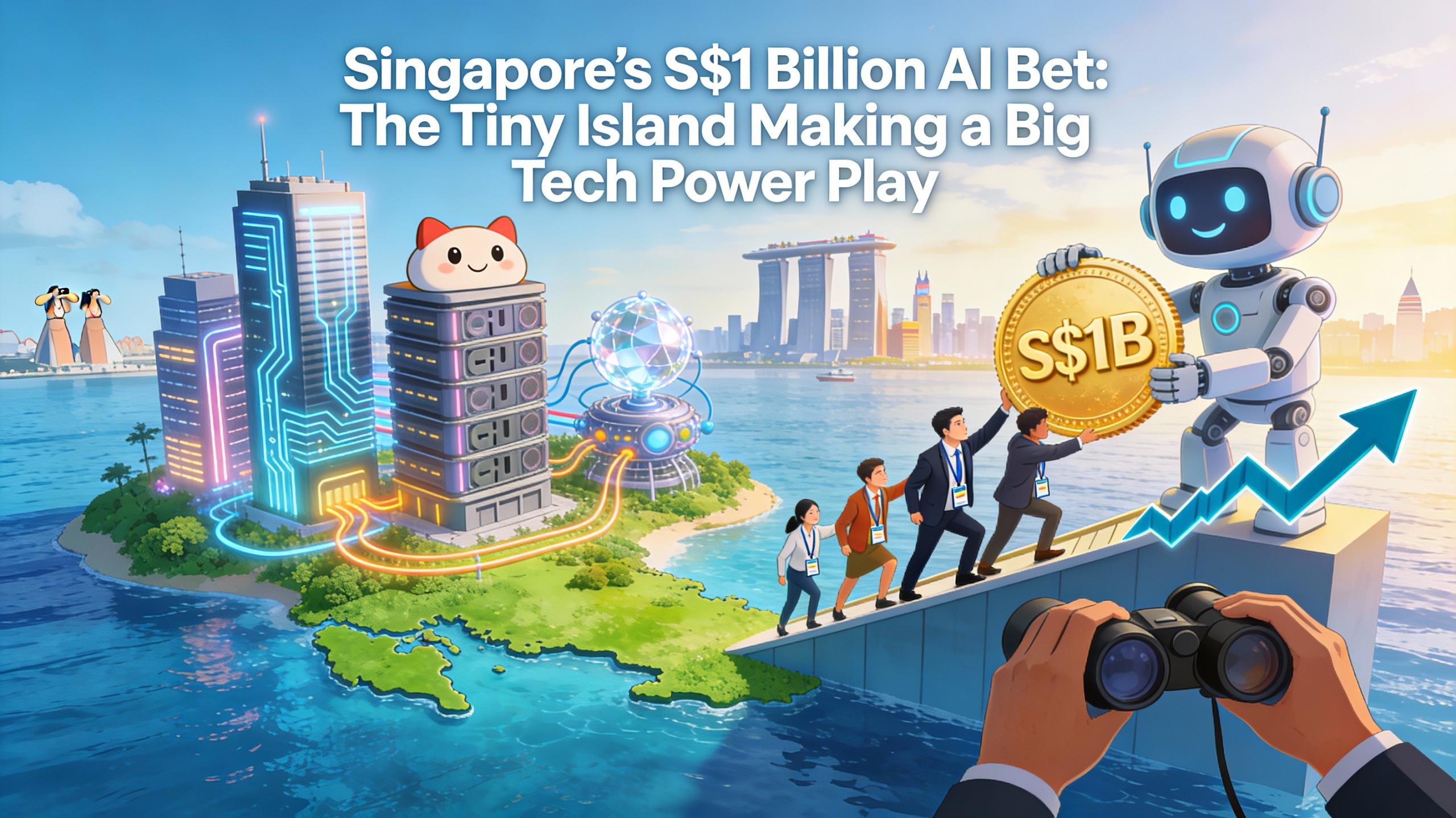
Singapore is writing a big‑tech future on a very small canvas, and it just sharpened the pen with more than S$1 billion (about US$779 million) in fresh AI and frontier‑tech funding over the next five years. This latest push cements the city‑state’s strategy: don’t try to outspend Washington or Beijing—out‑focus them,
The new capital falls under Singapore’s evolving National AI Strategy 2.0 and its broader Research, Innovation and Enterprise (RIE) framework, which already channels billions into advanced manufacturing, semiconductors, biotech, and quantum technologies. For investors, it is less an isolated budget line and more a signal flare that this jurisdiction intends to be a price‑setter, not a price‑taker, in the next computation cycle.
What the S$1 Billion AI Push Really Buys
At headline level, the new package is aimed at strengthening public sector AI capabilities, building local compute and talent, and aligning Singapore’s economy with an AI‑driven world. Beneath the official phrasing, the message is straightforward: the country wants to ensure its researchers and companies are renting fewer GPUs in someone else’s cloud and owning more of the value chain at home.
This funding sits on top of earlier commitments, including roughly US$554 million announced in 2024 to deepen national AI capabilities and support secure rollout of AI under NAIS 2.0. Add in targeted schemes such as “AI for Science,” backed by an additional S$120 million, and you get a policy mix that treats AI not as an app layer but as core scientific infrastructure. In Wall Street terms, Singapore isn’t just buying AI; it’s dollar‑cost‑averaging into the entire stack.
From AI Nation to Quantum Outpost
The new AI money arrives in a country that already behaves like a diversified technology ETF. Singapore has committed US$18.4 billion to public‑sector research under its RIE 2025 plan, with “Human Health and Potential” and deep‑tech domains such as quantum, advanced manufacturing, and biotechnology squarely in scope. That includes a dedicated National Quantum Strategy funded with about US$223.9 million to build a quantum ecosystem spanning research, talent, and commercialization.
On the ground, the strategy shows up as hard assets and real companies. Singapore accounts for roughly 10% of the global semiconductor chip market and about 20% of chip equipment production, anchoring its ambition to grow manufacturing output by 50% by 2030. At the same time, the government has launched focused quantum programs and co‑investment schemes that have helped the country capture about 58% of ASEAN venture funding and draw global investors into local quantum start‑ups. In a world where every major capital now talks about “chips, qubits, and talent,” Singapore has decided to specialize in being the place where all three actually ship.
Why Global Capital Should Care
For investors, Singapore’s AI and quantum push matters less for its absolute size and more for its signaling content. The United States, China, and the European Union are deploying vastly larger pools of money into advanced chips and quantum research, but Singapore’s approach is unusually targeted: it concentrates capital on commercialization pathways, industry partnerships, and talent programs rather than diffuse subsidies. That focus reduces policy noise and makes it easier for global funds to underwrite the risk.
The domestic response suggests the strategy is working. Early‑stage emerging‑tech start‑ups in Singapore raised about US$402 million in 2023, up 59% from the prior year, even as global venture funding cooled. In parallel, fintech and AI‑heavy firms continue to cluster in the city, supported by more than 1,300 local fintech companies and a pipeline of AI, blockchain, and quantum projects backed under MAS’s FSTI 3.0 scheme. When a small, open economy keeps attracting capital while everyone else complains about “higher for longer,” markets usually take notice.
The Smart‑Nation Trade: Data, Trust, and Scale
Singapore’s long‑running “Smart Nation” agenda is the backdrop that makes the new AI infusion more than a one‑off headline. The government has built out digital‑economy plumbing, from pervasive connectivity and 5G to AI governance frameworks like AI Verify and new model guidelines for generative AI. At the same time, regulators are tightening cyber‑ and data‑protection rules, responding to a surge in scams and cyber incidents and reinforcing the country’s pitch as a trusted data hub.
That combination—heavy digital usage, explicit AI ambition, and muscular regulation—creates an interesting trade for multinationals: ship your data‑intensive workloads and bleeding‑edge models to a jurisdiction that promises both scale and guardrails. Some of the world’s largest tech and life‑science companies have already responded, setting up AI innovation hubs and cloud, health, and fintech labs in Singapore. In effect, the country is offering investors a new asset class: jurisdictional premium on trust..
The Punchline for Markets
For public‑market investors, Singapore’s S$1‑billion‑plus AI push is unlikely to move a single mega‑cap chart on Monday morning—but it will increasingly shape where growth, listings, and strategic partnerships originate over the next decade. As AI, quantum, and advanced manufacturing converge, jurisdictions that provide stable rules, deep talent, and credible long‑term funding tend to become natural homes for premium multiples.
Singapore’s wager is that in a noisy world, discipline is alpha. While bigger economies debate how to fund the future, the city‑state is quietly doing what it usually does: sizing the position, managing the downside, and letting compounding do the rest. For investors watching the next wave of AI and quantum winners, ignoring that trade may turn out to be the most expensive risk‑free decision in the portfolio.
The Sources
- Singapore – Strategic Technologies, U.S. International Trade Administration
https://www.trade.gov/country-commercial-guides/singapore-strategic-technologies - “Singapore To Invest More Than S$1 Billion In AI Research And Development”
https://www.businesstoday.com.my/2026/01/24/singapore-to-invest-more-than-s1-billion-in-ai-research-and-development/ - “Further S$120M investment in ‘AI for Science’”, Singapore NRF / MDDI
https://www.mddi.gov.sg/newsroom/further-120m-investment-in-ai-for-science/ - National AI Strategy, Smart Nation Singapore
https://www.smartnation.gov.sg/initiatives/national-ai-strategy/ - “Singapore’s AI Strategy 2.0: Pioneering a Future of Innovation”
https://www.oreateai.com/blog/singapores-ai-strategy-20-pioneering-a-future-of-innovation/d2117b04a119b5243775800de2741dc5 - “Government Spending on Quantum Computing: Who’s Investing the Most?”
https://patentpc.com/blog/government-spending-on-quantum-computing-whos-investing-the-most-latest-stats - “Quantum in Singapore: Opportunities for collaboration to drive growth”
https://www.gov.uk/government/publications/quantum-in-singapore-opportunities-for-collaboration/quantum-in-singapore-opportunities-for-collaboration-to-drive-growth - “The History of AI – Part 2: Singapore’s AI Journey”
https://www.tech.gov.sg/technews/the-history-of-ai-part-2-singapore-ai-journey/
Stay Updated with Vista Partners
Subscribe to receive market insights, investing ideas, and the latest updates directly in your inbox.