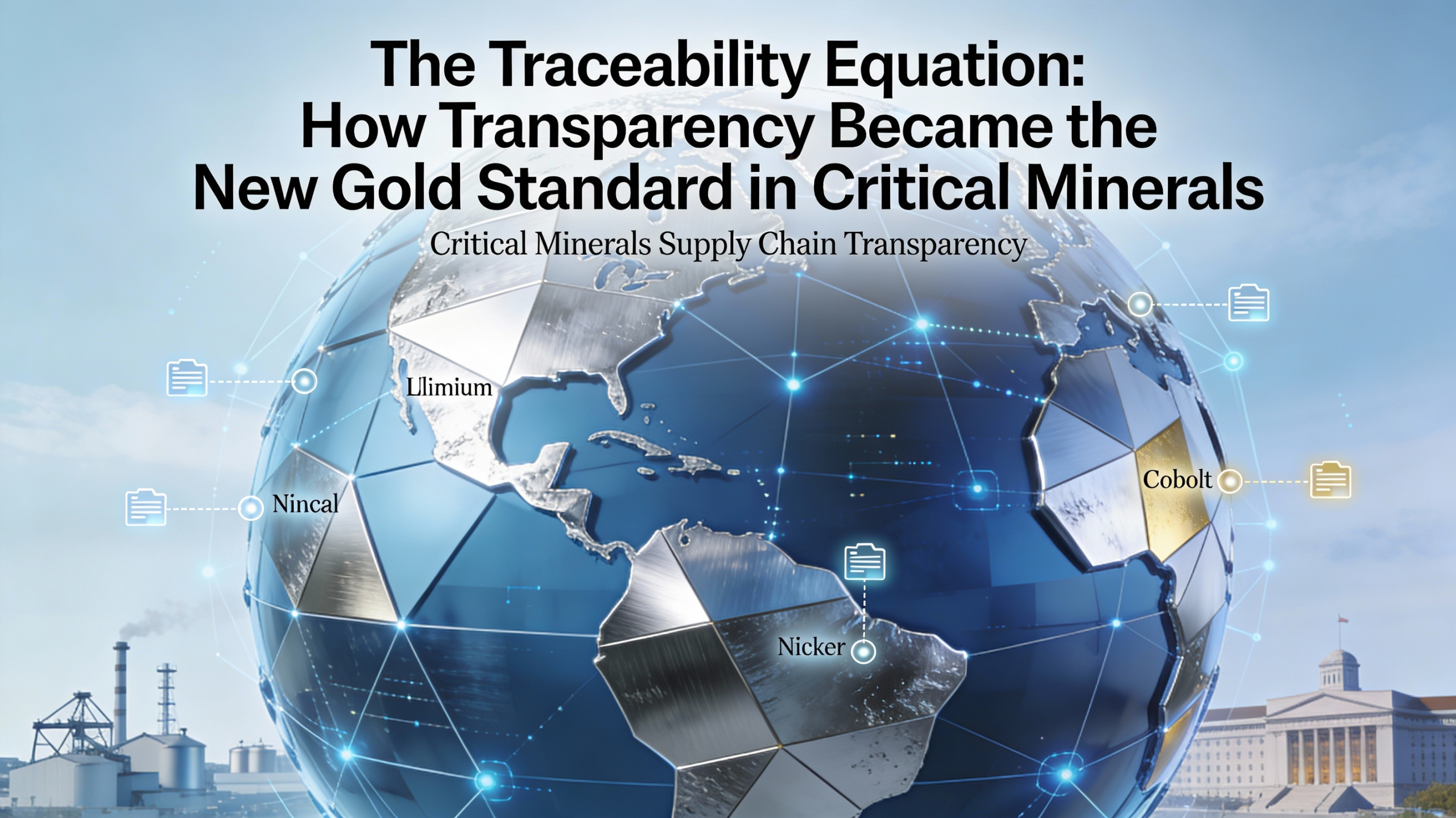
There was a time when a shiny rock was simply a shiny rock. Today, it’s a data point — and possibly a diplomatic tool. The global critical minerals race, once defined by tonnage and tariffs, has entered a new phase in which traceability is as valuable as the ore itself.
Ellen Carey, a veteran of policy corridors and boardrooms alike, describes it as “seeing upstream with clarity.” In her conversation with Alberto Rosende, CEO of M2i Global (MTWO), on The Minerals Metals Initiative, Carey makes a persuasive case that visibility — not just supply — is the modern currency of resource security. With nickel and lithium markets as volatile as a caffeine-fueled trader, her argument carries both economic and geopolitical weight.
Mining for Truth in a Cloud of Uncertainty
For years, nation-states have fretted over where materials like cobalt and graphite actually come from — and more importantly, under whose influence. Traceability, Carey notes, offers a simple answer to a complex dilemma: a mechanism to distinguish allied production from less transparent sources. Think of it as a moral metal detector buried deep in the global supply chain.
Through digital ledgers, blockchain tagging, and a growing network of certification frameworks, traceability is evolving from a feel-good initiative into a strategic advantage. The ability to prove provenance isn’t just about ESG bragging rights — it’s about unlocking procurement deals, tax credits, and investment capital that increasingly favor clean, verifiable sourcing.
Policy Meets Pragmatism
Under Alberto Rosende’s leadership at Mi Global, the conversation around minerals has migrated from abstract strategy sessions to the machinery of real-world implementation. Rosende, a man who seems equally comfortable in a mine shaft or a minister’s office, sees traceability as a way to fuse sustainability with sovereignty.
“We’re not just mapping rocks,” he quipped in the episode. “We’re mapping resilience.” That blend of humor and foresight reflects a growing consensus: that economic durability depends on understanding — and proving — the origins of the materials that power modern industry.
Following the Digital Breadcrumbs
Carey’s prior work at Circulor exemplifies how traceability tools are now hardwired into trade and finance systems. From the Inflation Reduction Act’s mineral origin requirements to corporate disclosures demanded by automakers and electronics firms, traceability has turned into a compliance art form.
And while it may sound like a bureaucratic exercise, the rewards are tangible. Manufacturers paying premiums for transparent sourcing can now justify those costs to regulators, investors, and consumers with a clear conscience — and cleaner data. In today’s market, visibility is not just virtuous; it’s bankable.
The New Alchemy of Accountability
If the old industrial economy was fueled by extraction, the new one thrives on illumination. Traceability transforms an opaque global marketplace into a map of trust — a delicate alloy of governance, innovation, and commercial logic.
Carey and Rosende’s dialogue suggests a rare optimism in a sector often defined by scarcity. With the right mix of transparency and technology, the critical minerals industry may finally prove that accountability is more than just a line item — it’s a competitive edge.
Watch The Entire Interview Now
Stay Updated with Vista Partners
Subscribe to receive market insights, investing ideas, and the latest updates directly in your inbox.